Porthos
Porthos, whose real name is never revealed in the novel, is the most physically imposing and ostentatious of the three inseparable Musketeers. A giant of a man with a haughty countenance, he is defined by his immense strength, his insatiable vanity, and his love for all things grand—from his magnificent baldric to the splendid feasts he arranges. Unlike the mysterious and melancholic Athos or the intellectual and romantic Aramis, Porthos is a creature of pure appetite and display, a blustering but fundamentally good-natured braggart whose adventures provide much of the novel's comic relief and whose financial schemes drive several key subplots.
Identity and Introduction
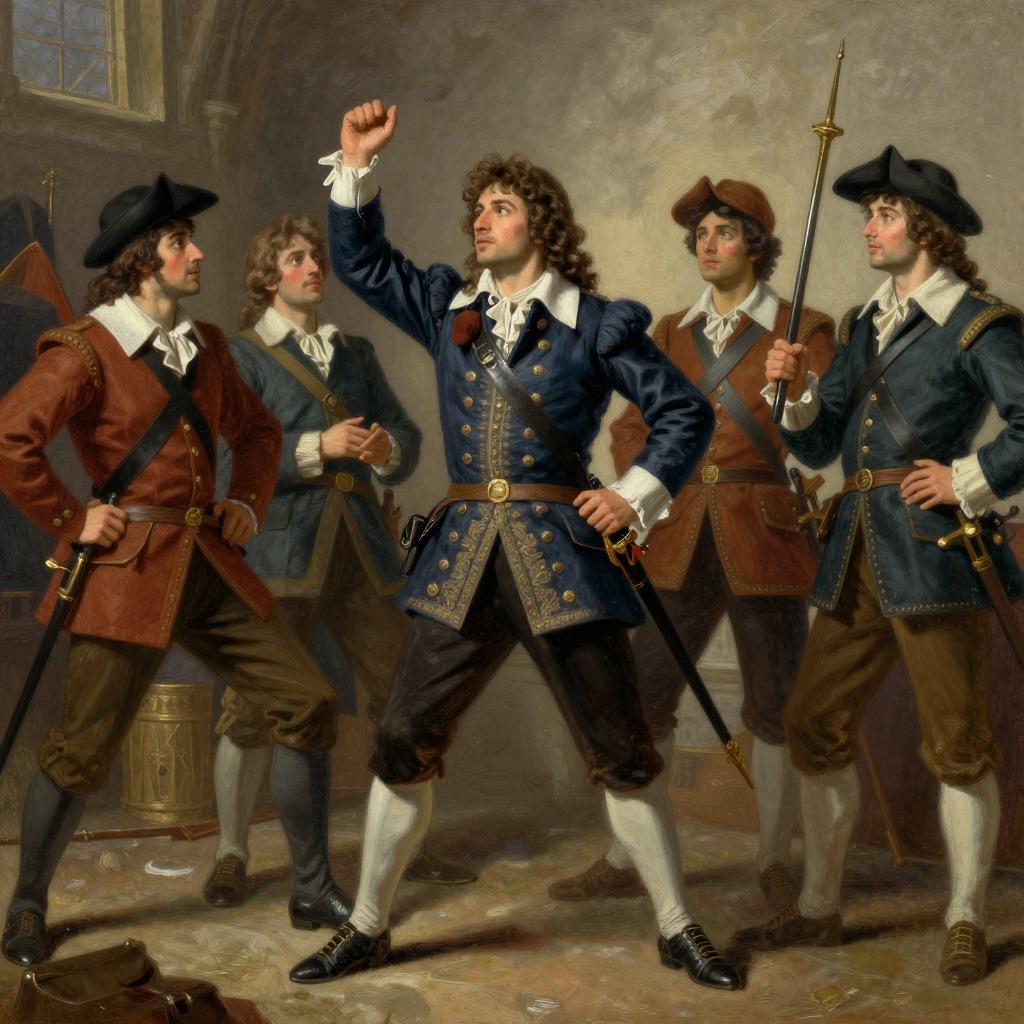
Porthos is first encountered in the antechamber of Monsieur de Treville, immediately drawing attention by his peculiar costume. He wears a cerulean-blue doublet, a little faded, and over it a magnificent baldric worked in gold that shines like water ripples in the sun. A long cloak of crimson velvet falls from his shoulders, and he coughs affectedly, claiming a cold to justify wearing it. When d'Artagnan first sees him, Porthos is the center of an animated group, and his companions tease him about the baldric, suggesting it was a gift from a veiled lady rather than purchased with his own inheritance. Porthos insists he paid twelve pistoles for it, a claim met with continued doubt. He is described as a stout man of about two- or three-and-twenty, with an open, ingenuous countenance, a black, mild eye, and cheeks rosy and downy as an autumn peach. His delicate mustache marks a perfectly straight line upon his upper lip, and he habitually speaks little and slowly, bows frequently, and laughs without noise, showing his fine teeth. This initial portrait establishes him as a man of immense pride in his appearance, a trait that will define much of his behavior.
Arc Through the Plot: Bravery, Boasting, and Financial Schemes
Porthos's role in the plot is largely defined by his physical courage and his constant, often comical, pursuit of money to maintain his lavish lifestyle. He is a fearless fighter, as demonstrated in the famous battle against the Cardinal's Guards at the Carmes-Deschaux, where he fights Bicarat with skill and determination. However, his bravery is often undercut by his vanity. After the journey to England, he is left behind at Chantilly, supposedly with a strained knee from a duel. The innkeeper reveals the truth: Porthos was quickly defeated by a stranger who was actually seeking d'Artagnan, and he has been lying about the severity of his wound to save face. He has also gambled away all his money, including his horse, and is now a virtual prisoner in the inn, running up a large bill for food and wine. His servant, Mousqueton, forages for provisions to keep them fed. This episode perfectly encapsulates Porthos's character: a brave man whose pride and love of pleasure constantly lead him into humiliating predicaments. Later, when the four friends need money for their campaign equipment, Porthos is the one who first finds an idea, which leads him to the church of St. Leu to manipulate his mistress, the procurator's wife, Madame Coquenard.
Relationships and Conflict: The Procurator's Wife and the "Duchess"
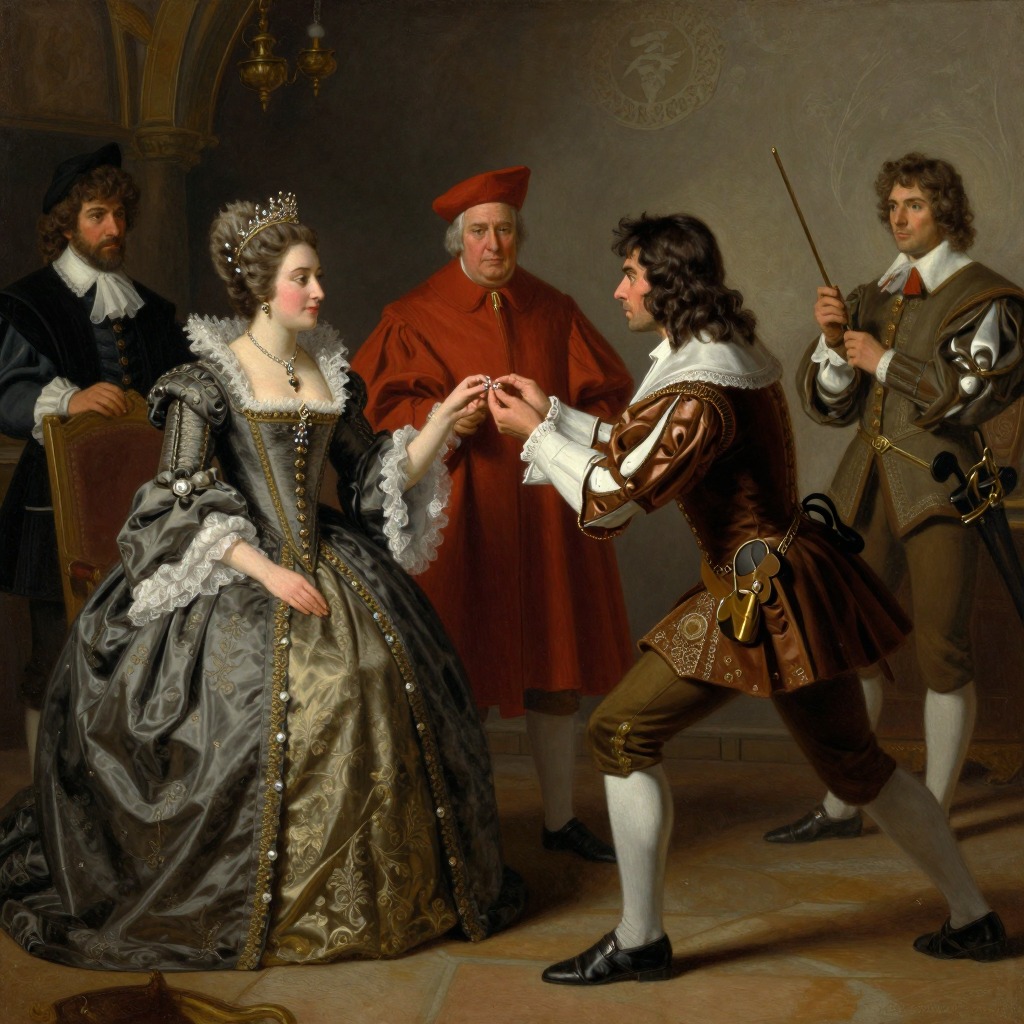
Porthos's primary relationship outside the Musketeers is with Madame Coquenard, the wife of a miserly procurator. He boasts to his friends that she is a great duchess, but the truth is far more mundane. The innkeeper at Chantilly reveals that Porthos's "duchess" is actually the old wife of a procurator, a woman of at least fifty who lives in the Rue aux Ours. Porthos's entire scheme to equip himself for the campaign hinges on extracting money from her. He stages a dramatic scene in the church, pretending to court a beautiful lady (who is actually Milady) to make Madame Coquenard jealous. He then feigns a cold and wounded heart, lamenting that he will be killed in the coming war because he cannot afford proper equipment. The ruse works. Madame Coquenard, desperate to win back his favor, agrees to provide him with a horse, a mule, and eight hundred livres. Porthos's relationship with her is a masterful blend of manipulation and farce, revealing his cunning beneath the bluster. He is also a loyal friend, though his contributions to the group's plans are often more physical than intellectual. He is quick to offer his strength in a fight and his loud voice in an argument, but he is also the most easily led, often needing Athos or d'Artagnan to explain the subtleties of a situation.
Change and Ending: From Musketeer to Married Man
Porthos undergoes a significant, if not deeply introspective, change by the novel's end. His primary goal throughout the story has been to secure wealth and status, and he achieves this in a way that is perfectly consistent with his character. After the siege of La Rochelle, he leaves the Musketeers. The husband of his duchess, Monsieur Coquenard, conveniently dies, and Porthos marries the widow. The coveted coffer, which he had long dreamed of, contains eight hundred thousand livres. He thus abandons the adventurous life of a Musketeer for the comfortable, prosperous existence of a married man. His servant, Mousqueton, finally achieves his ambition of standing behind a gilded carriage. Porthos's ending is a triumph of his materialistic and pragmatic nature. He does not seek glory or a higher rank like d'Artagnan, nor does he retreat into melancholy or religion like Athos and Aramis. He simply cashes in his chips and enjoys the wealth he has so cleverly, and sometimes comically, pursued.
Thematic Significance: The Body and the Purse
Porthos represents the physical and materialistic pole of the Musketeer quartet. He is the body to Athos's soul, Aramis's spirit, and d'Artagnan's ambition. His story is a constant negotiation between his immense physical appetites—for food, drink, fine clothes, and women—and the practical need to finance them. His vanity is not a flaw that leads to tragedy but a driving force that leads to comedy and, ultimately, success. He is the most straightforward of the four, a man of action rather than thought, whose loyalties are simple and whose desires are transparent. His eventual marriage to Madame Coquenard, a woman far beneath the social station he pretends to occupy, is a perfect symbol of his character: a grand, boastful exterior that ultimately settles for a comfortable, bourgeois reality. He is the proof that in the world of The Three Musketeers, a man can be a fool and a braggart, yet still be brave, loyal, and ultimately rewarded.